

Why do your questions grow more complex as you grow?
You may start wondering how a rainbow is formed or how a simple machine functions.
As you grow up, your questions reflect a more profound thought process, such as how a mathematical model fits into real life, or how innovation can solve world issues.
Your curiosity increases, but what really shapes your learning is how you direct your questions!
The International Baccalaureate Diploma Programme (IBDP) allows you to address your curiosity with key concepts that provide direction and meaning to inquiry.
You start asking critical questions, linking knowledge across disciplines, and solving problems in a multidimensional way.
This guide will help you understand how these overarching ideas form the foundation of IB learning. You will get insights on how these concepts can help you become a reflective, analytical, and globally aware thinker.
The IB curriculum is modelled around a set of core ideas which foster significant knowledge and critical thinking.
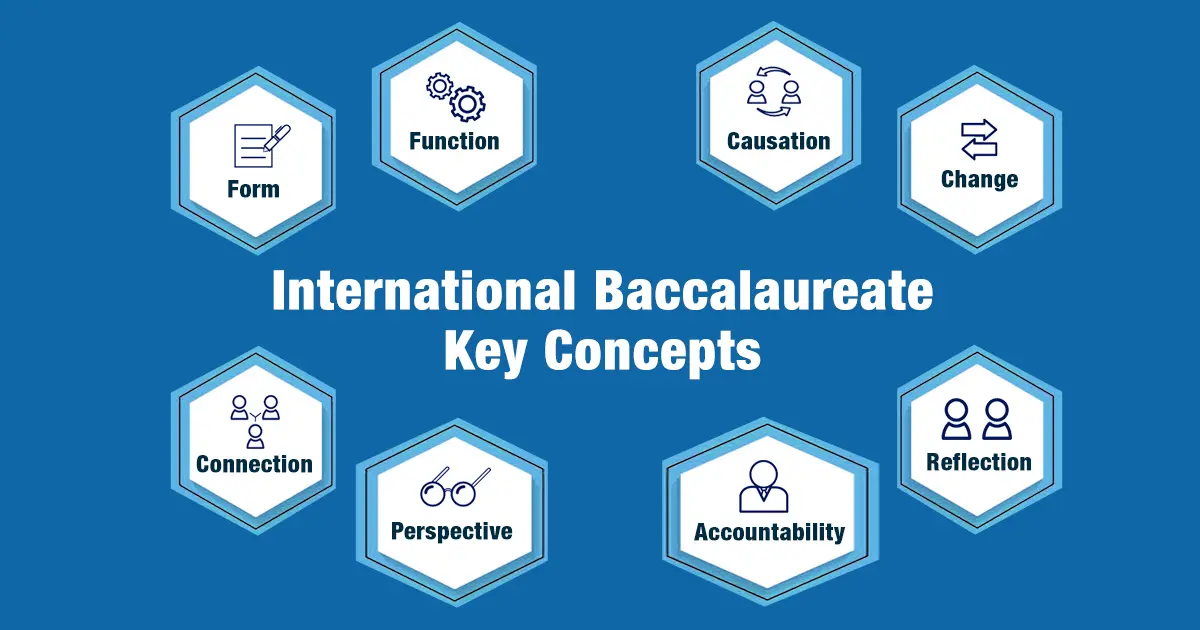
The International Baccalaureate key concepts are the basis of all the subjects and serve to deepen your inquiry skills, to draw parallels among subjects and to apply learning to life.
These IB key concepts are not only relevant to academic achievements, but also to the development of the critical skills that are highly valued by universities and employers around the world.
Let us look at the IBDP key concepts:
These IB key concepts encourage you to go beyond rote memorisation and think critically and meaningfully.
For example, imagine you are studying how cells function in your IB Biology class. You will find yourself wondering how cellular processes can be related to diseases or environmental systems using the IB key concepts. It is this interconnected and multifaceted thinking that makes an IB learner stand out.
Each IB programme has customised a list of key concepts suited to your learning goals. Following are the ways International Baccalaureate key concepts are integrated into learning:
The IBDP key concepts matter because they help you:
For example, when you take IB Mathematics, you do not simply memorise formulas and calculations. You will also begin to wonder how information can shape opinion, and the society at large.
When you think at this level, you will naturally become a curious learner who seeks knowledge actively and grows into a thoughtful, compassionate leader.
These key concepts are carefully used in IB World Schools to develop engaging, academically challenging, interdisciplinary units. One unit can entail several subjects, all connected through one central concept that gives the learning a clear and meaningful focus.
Another example to learn this approach is given below:
Unit Theme: Innovation and Society.
Key Concept: Change
Subjects Involved:
This type of structure makes learning dynamic and interconnected. It reflects real life, where issues and changes are seldom confined to a single domain of interest but are overlapping and mutually reinforcing.
The more you study such units, the more you are urged to explore the issues around you on a deeper and broader level, thereby developing your academic knowledge and understanding the world around you.
Subject-specific concepts are also used to add depth and flexibility to the curriculum. They allow learning to be customised, so that even focused academic support can remain concept-driven and aligned with the broader IB philosophy.
The IB key concepts are the foundation of purposeful, inquiry-driven learning. They transform curiosity into structured thinking. They help you address the real-world challenges with confidence and depth.
IB schools play a pivotal role in embedding these key concepts into everyday teaching and learning.
By designing concept-driven, interdisciplinary units and fostering inquiry in every classroom, schools can empower learners to think critically and act responsibly.
A1: The IB key concepts are broad, guiding ideas such as Form, Function, Causation, Change, Connection, Perspective, Responsibility, and Reflection. They help you explore subjects deeply and think critically across disciplines.
A2: There are eight main key concepts in the IB framework that shape inquiry-based learning and interdisciplinary understanding.
Recent Blogs
Site Designed and Maintained By : Office of Communications, JAIN Group All rights reserved.