
The International Baccalaureate (IB) curriculum is a globally recognised educational programme that emphasises critical thinking and holistic development. This guide explores the IB curriculum meaning, core components, subject groups and benefits. Going through the blog can help learners understand the IB curriculum better.
The IB offers four main programmes: Primary Years Programme (PYP, ages 3-12), Middle Years Programme (MYP, ages 11-16), Diploma Programme (DP, ages 16-19), and Career-related Programme (CP, ages 16-19).
The IBDP programme stands out among all these levels for its rigorous curriculum. Introduced in 1968, the IB Diploma Programme (DP) was the first programme launched by the IB organisation. It is widely recognised by leading universities worldwide. The programme is offered by more than 6000 schools in over 160 countries. It has wide acceptance in India, with over 170 schools offering the programme to learners aged 16 - 19 as a pre-university (Grade 11 - 12) course.
The IB curriculum extends beyond rote learning, focusing on inquiry-based learning for young learners. Understanding the IB curriculum meaning can help learners make better career decisions about the programme.
The IB program curriculum is a rigorous, internationally recognised framework designed for the learners of the IBDP programme. It focuses on inquiry, critical thinking, and holistic development.
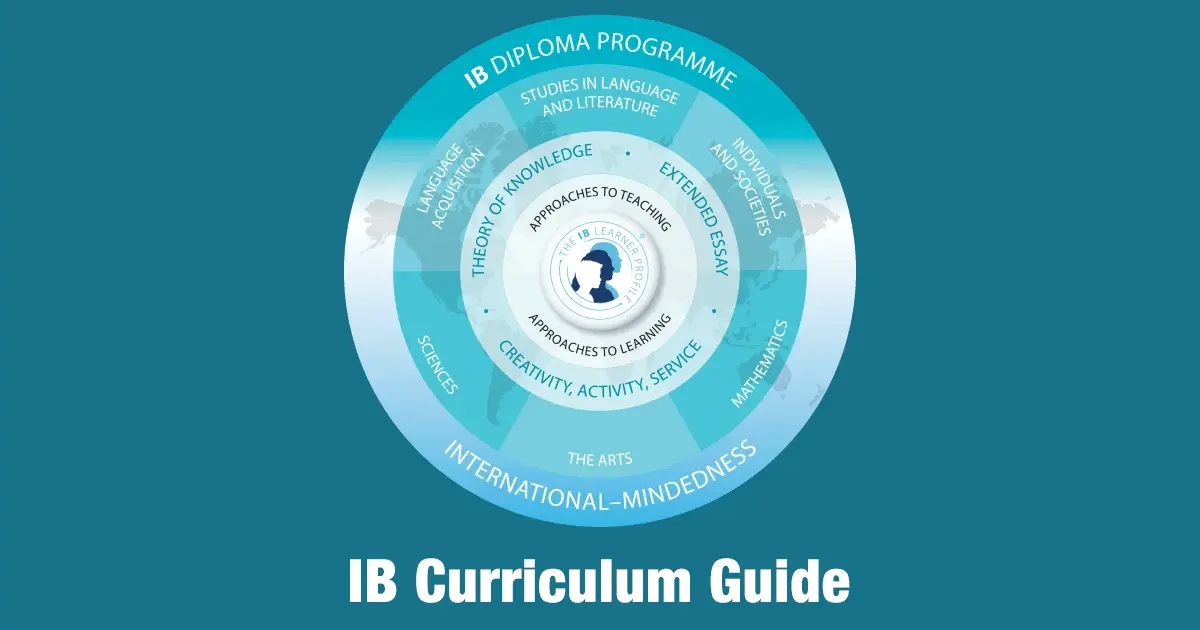
The IBDP curriculum comprises the DP core and six subject groups. This forms the pinnacle of the IB programme, requiring learners to complete a rigorous course of study. The curriculum is offered at two levels: Standard Level (SL) and Higher Level (HL).
The IBDP curriculum integrates three mandatory core components: Theory of Knowledge (TOK), Extended Essay (EE), and Creativity, Activity, Service (CAS). TOK deals with knowledge questions.
The IB curriculum subjects are classified under different subject groups. Learners must choose six subjects in total.
The IBDP curriculum includes three additional components apart from the six subjects. This includes:
The International Baccalaureate curriculum includes assessments that primarily test the learners critical thinking abilities and global awareness. The external assessments of the chosen subjects are written exams at the end of the programme. These can include essays, structured problems, data-response, text-response and case-study questions.
The IBDP curriculum also has internal assessments that involve oral presentations, essays, and research proposals. These internal assessments are an important component of the IB subjects.
Every subject is graded on a scale of 1 - 7, with 7 being the highest score. To earn the IB diploma, learners require a minimum of 24 points out of 45. Higher scores help increase chances of admission into top universities.
The IB program curriculum develops globally minded learners ready for diverse challenges.
In summary, the International Baccalaureate Diploma Programme (IBDP) is a transformative curriculum that guides 16 - 19 year old learners. It blends academic rigour with personal growth through core components such as TOK, Extended Essay, and CAS. By mandating six subjects across key groups, IB ensures broad exposure. Choosing this widely recognised programme can help increase the chances of admission to institutions for IB learners.
Check out the IBDP programme at JAIN International Residential School, one of India’s top IB schools, and start your journey of holistic growth.
A1. Yes, the International Baccalaureate curriculum is fully recognised in India. The Association of Indian Universities (AIU) recognises IBDP as equivalent to the Senior Secondary School (Grade 11 and 12).
A2. The International Baccalaureate (IB) is an independent global education organisation founded in Switzerland in 1968. The curriculum is neither British nor American. Universities in the UK, the US and several other countries accept the programme.
A3. The IB curriculum develops critical thinking, holistic learning and global-mindedness. This makes it suitable for students looking for a broad learning experience. The British curriculum (A-Levels), on the other hand, offers greater depth, structure, and specialisation, making it better suited for students who excel in exam-focused, academic learning.
A4. IB excels in global recognition and project-based learning across subjects. In comparison, ICSE (Indian curriculum) emphasises detailed language and application-based studies suited for Indian exams. IB is more suited for admissions in global universities.
Recent Blogs
Site Designed and Maintained By : Office of Communications, JAIN Group All rights reserved.