

Geometry originated in ancient Egyptian and Babylonian civilisations 3000 years ago. It originated from the need to measure land and build structures. The word ‘Geometry’ is derived from the Greek words ‘geo’ and ‘metria’, which means measurement of the earth. The concept of Geometry finds applications in modern fields such as Engineering, Robotics, and Medical Imaging.
The branch of Mathematics that studies points, lines, angles, surfaces, and solids. Geometry uses theorems to turn logical observations into universal principles. It has adapted to the contributions from areas of Physics, Computing and Biology. The field is divided into several types based on shapes and dimensions.
Geometry finds applications in real-world fields such as construction, engineering, art, computer graphics, and medical imaging. Geometry transforms abstract concepts into concrete, actionable data. It helps understand spatial relationships around 3D objects, enabling predictive modelling in fields such as robotics, virtual reality and urban planning. The importance of Geometry applies to fields such as Physics, Engineering, Computer Science and Technology. In Physics, it helps understand concepts of celestial mechanics and orbit calculations. It is used for mechanical building designs, computer graphics, data analysis and more in fields such as Engineering and Computer Science.
Geometry is the branch of Mathematics that is divided into Euclidean (flat space), Non-Euclidean (curved space), Analytical (coordinate), Differential (calculus), and Topology (spatial properties). It also includes 2D Plane Geometry and 3D Solid Geometry.
The primary types of Geometry include:
| Type of Geometry | Definition |
| Plane Geometry | Plane geometry studies two-dimensional shapes (2D) such as triangles, quadrilaterals, polygons and circles. |
| Solid Geometry | Involves studying three-dimensional (3D) objects and spatial measurements of prisms, pyramids, cylinders, cones, and spheres. |
| Coordinate Geometry | This type of Geometry uses algebra and coordinates to represent and analyse geometric figures. It describes the link between Geometry and algebra through graphs involving curves and lines. |
| Euclidean Geometry | It is the foundation for studying flat surfaces. Developed by Euclid, this type of Geometry is based on five key postulates regarding points, lines, and planes. It analyses shapes, angles, and 2D or 3D figures. |
| Non-Euclidean Geometry | This type of Geometry is best for studying curved surfaces and spaces. Euclid’s parallel postulate does not apply to these shapes, resulting in geometries with elliptic (positive) or hyperbolic (negative) curvature. |
Geometric shapes serve as the foundational building blocks of spatial design, defined by the specific arrangement of lines, points, angles, and curves. These figures are broadly categorised into two-dimensional (flat) planes and three-dimensional (solid) forms. The primary examples of 2D include circles, triangles, rectangles, quadrilaterals, and trapezoids. Three-dimensional shapes include cubes, spheres, cones, and cylinders.
Basic geometry theorems provide the fundamental principles for comprehending shapes, angles, and lines. These geometrical shapes have real-world applications in fields of Engineering, Art, Technology, and Digital graphics.
Geometry theorems serve as a foundational basis for understanding shapes, angles, and lines. These theorems mostly cover triangles, polygons, and circles.
Key basic Geometry theorems include:
Geometry formulas are essential mathematical tools crucial for calculations in dimensions, perimeter, area, surface area, and volume. These basic Geometry formulas hence help solve problems across plane and solid Geometry.
|
2D Shapes Formulas |
|
|
Triangle |
Area = 1/2×base×height Perimeter = sum of sides a+b+ca+b+c |
|
Rectangle |
Area = length×width |
|
Square |
Area = side2 |
|
Parallelogram |
Area = base×height |
|
Trapezoid |
Area = (base1+base2)/2 ×height |
|
3D Shapes Formulas |
|
|
Cube |
Volume = side3 |
|
Cuboid |
Volume = length×width×height |
|
Cylinder |
Volume = πr2h |
|
Sphere |
Volume = 13πr2h |
|
Pyramid |
Volume = 43πr3 |
|
Coordinate Geometry Formulas |
|
|
Distance between points |
(x2−x1)2+(y2−y1)2(x2−x1)2+(y2−y1)2 |
|
Midpoint: |
(x1+x2/2 2,y1+y2/2) |
Q1. Find the perimeter of the given rectangular garden with a length of 10 cm and a breadth of 4 cm.
A1. Given that the length of the rectangular garden is 10 cm, the breadth of the rectangular garden is 4 cm.
Using the perimeter formula;
= 28 cm.
This determines the wire needed to enclose the garden plot.
Q2. Find the area of the given triangular roof section with a base of 17 cm and a height of 10 cm.
A2. Given the base of the triangular roof section is 15 cm and the height of the triangular roof section is 10 cm. Using the formula;
= 85 cm².
Q3. Find the volume of the given cubic storage box with a side length of 7 cm.
A3. Given the side length of the cubic box is 7 cm, the volume can be calculated using the formula;
= 343 cm³.
Geometry finds applications in various real-life situations. Engineering, technology, fashion, and medicine use Geometry. Uses of Geometry span from sports field design, equipment design, and optimising plays. Stadiums use rectangular pitches, goal arcs for basketball and football. Technologies such as CGI (Computer-Generated Imagery) use vector Geometry for 3D rendering, and GPS triangulates. Nature also shows Geometry through beehives’ hexagons, shapes of leaves, flowers, stems, roots, and bark. Geometry theorems are vital for the construction of bridges, MRI reconstructions, and prosthetics.
In conclusion, Geometry is an important branch of mathematics that explores spatial relationships. It covers various types of plane, solid, and coordinate systems, alongside foundational theorems. The basic Geometry formulas help in calculating areas, volumes, and perimeters of triangles, quadrilaterals, and circles that have real-life applications. Geometry applies to real-world phenomena such as the symmetrical honeycombs and spherical fruits. They also apply to proportional architectures, sports field designs, trajectories, constructions and more.
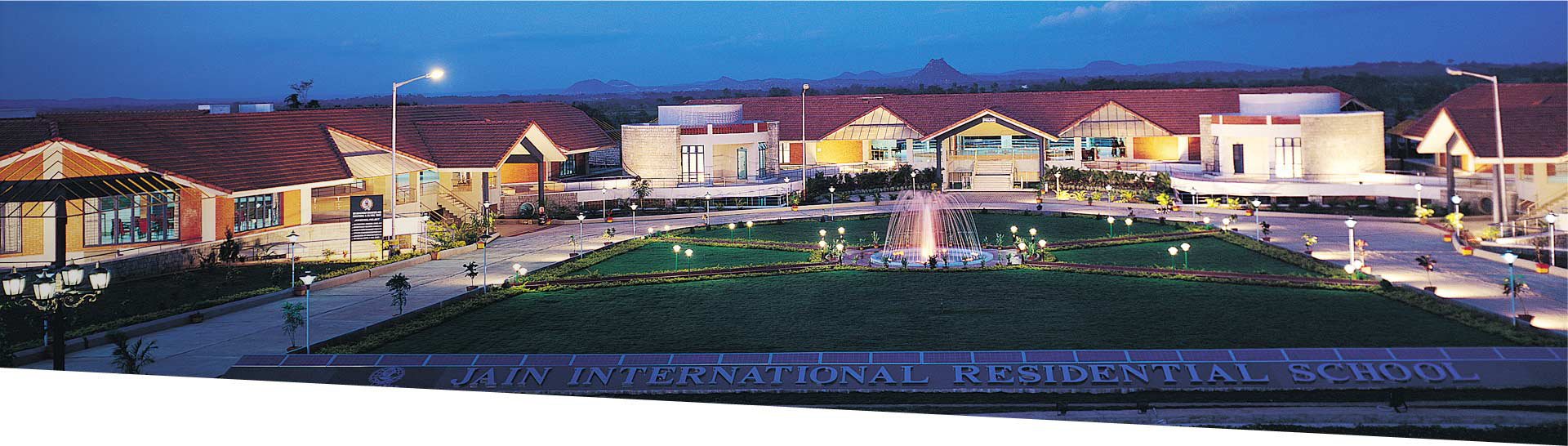
Geometry is an important topic taught in middle & high school. Several schools in India offer expert guidance in these topics, with JAIN International Residential School (JIRS) being one of the leaders in this industry.
A1. Geometry is a branch of mathematics that studies the properties, measurements, shapes, sizes, positions, and spatial relationships of shapes. These include points, lines, angles, surfaces, and solids.
A2. Geometry is used in various real-life situations and fields. It helps measure, design, and navigate the physical world. Applications range from construction, art, technology, sports, medical imaging and more.
A3. 2D shapes are flat, two-dimensional plane figures with only area and perimeter. Triangles, rectangles, and polygons are some of the examples. 3D shapes are solid, three-dimensional objects that occupy space, have volume and surface area. Examples include cylinders, pyramids or cubes.
A4. Algebra uses variables, equations, and symbols to represent variables and solve for unknown numerical values. Geometry focuses on visual shapes, spatial properties, and measurements such as angles or distances.
A5. A plane is a flat, two-dimensional surface extending in all directions. It contains points/lines but no thickness. It is foundational for 2D shapes, such as triangles, and serves as a reference for 3D coordinates.
Recent Blogs
Site Designed and Maintained By : Office of Communications, JAIN Group All rights reserved.